






Everything you need to know about 'Chris & Martina: The Final Set'

They're two of the greatest champions in history, and two of the most notable trailblazers in women's sports.
And now, decades removed from their iconic rivalry, and as their relationship has grown and evolved, they're getting the Netflix treatment.
This is everything you need to know about the upcoming documentary "Chris & Martina: The Final Set," which premieres on Netflix on June 26.
What does the documentary cover?
Directed by two-time Emmy Award winner Rebecca Gitlitz, "Chris & Martina: The Final Set" covers the legendary, and often contentious, rivalry between Evert and Navratilova in the 1970s and 1980s.
They were contrasting figures -- the All-American Evert, from Florida, and Navratilova, who defected from communist Czechoslovakia.
At first it was Evert who had the upper hand in the rivalry, winning nine of their first 10 matches and getting all the fame and acclaim.
"In the beginning, it was fine for me to be friends with her, because I was better than her," Evert, 71, says in the film.
But that would change. Navratilova became fanatical about her fitness level and training and eventually caught up to Evert, and they would compete fiercely in the ensuing decades, taking women's tennis to new heights.
"Chris was the enemy, and she’s the one I had to beat to get to No. 1," Navratilova, 69, says.
Their relationship would change throughout the years, from friendly -- they won the French Open doubles title together in 1975, before Evert disbanded their team -- to icy to cordial.
But later in life, when they were both diagnosed with cancer and became more introspective, they developed a deep emotional bond over their treatments, their struggles, their sacrifices and their shared place in history.
"Sometimes it takes terrible things to happen for you to realize how you really feel about things," Evert says.
When does it come out?
"Chris & Martina: The Final Set" will have its world premiere on Wednesday, June 10 at the Tribeca Film Festival in New York City.
It will then become available on Netflix on June 26.
What makes this documentary unique?
There's been no shortage of Evert and Navratilova media coverage over the past five decades, but "Chris & Martina: The Final Set" features never-before-seen footage and rare interviews.
"Every time I practice, I’ll be practicing shots that I’ll hopefully use against her," a young Evert says in a decades-old interview from her playing days.
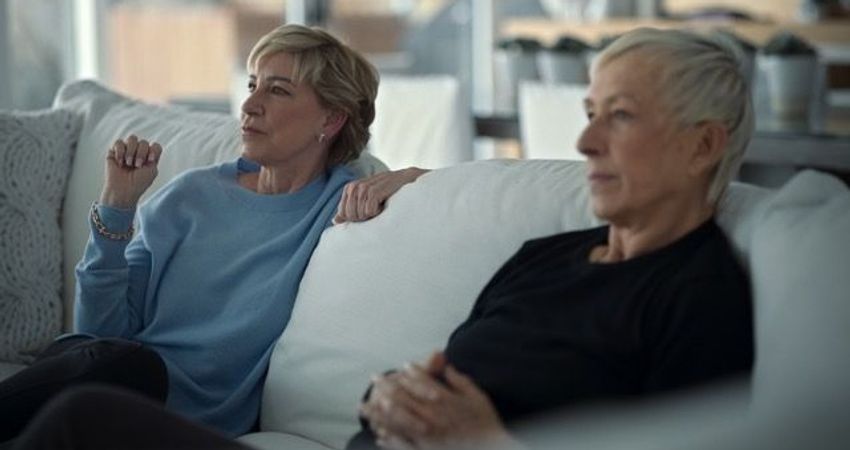
There's also footage of Evert and Navratilova watching some of their classic matches together, commenting on specific points and explaining the emotions that they were experiencing after euphoric wins and devastating losses, at times bringing them to tears.
In the darker parts of the documentary, Evert and Navratilova are seen getting cancer treatments and meeting with doctors about future plans and prognoses.
"The second time really hit home how precious every moment is, how precious life is," Evert says about her ovarian cancer returning.
Adds Navratilova in regard to how their relationship had evolved: "There’s no competition of whose cancer was worse. We’re in the same boat."
As dark as those moments are, it's equally uplifting and heartwarming to see them embrace, support each other and share positive news about their progress.
In addition to Navratilova and Evert, the documentary includes interviews with soon-to-be Hall of Fame inductee Mary Carillo, seven-time Grand Slam singles champion John McEnroe, Evert's brother John, former World No. 3 Pam Shriver and former Washington Post and Sports Illustrated writer Sally Jenkins.
Evert and Navratilova's rivalry, by the numbers
Evert and Navratilova played an almost incomprehensible 80 times between 1973 and 1988, with the latter winning the back-and-forth head-to-head 43-37.
Of the 80 matches, 60 came in finals and 14 came in Grand Slam finals.
Navratilova won 36 of the 60 title matches, including 10 of the Grand Slam finals. Some of their most memorable Grand Slams finals were 1978 Wimbledon, which Navratilova came from behind to win, Navratilova's three-set win at the 1981 Australian Open and Evert's triumph at the 1985 French Open.
From November 1975 until August 1987, either Evert or Navratilova held the No. 1 ranking in 592 of the 615 weeks. Evert held the top spot for 260 weeks in her career (fourth most all-time), and Navratilova held it for 332 weeks (second most all-time). They each finished as year-end World No. 1 seven times.
Navratilova won 167 singles titles and 177 doubles titles, to Evert's 154 singles titles and 18 doubles titles.
They both won 18 Grand Slam singles titles. Navratilova's nine Wimbledon titles are the most all-time, and Evert's seven French Open titles are the most all-time in the women's game.
It's widely regarded as the greatest rivalry in tennis history.